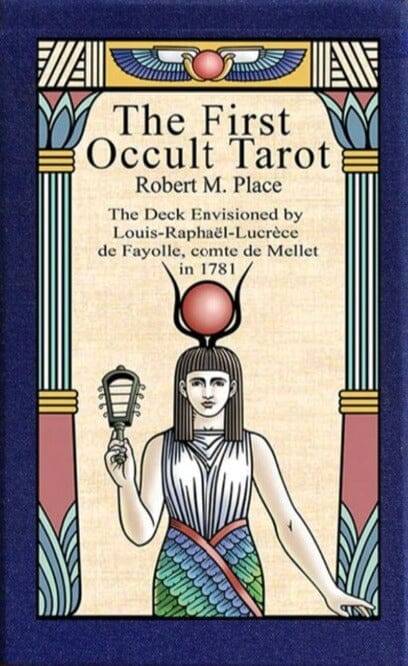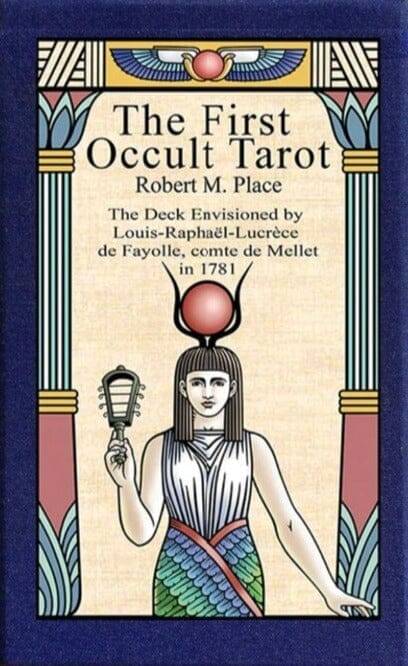
The First Occult Tarot Deck by Robert M. Place
The First Occult Tarot draws its inspiration from the writings of Louis-Raphaël-Lucrèce de Fayolle, comte de Mellet, one of the earliest French thinkers to propose an esoteric foundation for the tarot. De Mellet connected the Major Arcana to the Classical Ages of Man, the Hebrew alphabet, and early divination practice, all filtered through a deeply Hermetic worldview. Robert M. Place has given these ideas a physical form through his own refined artistry, producing a deck that feels both ancient in spirit and fresh in execution.
Rather than following the Marseille tradition, Place turned to the Besançon Tarot as his structural model, and the sequence moves from the World back to the Fool, tracing a descent from the Age of Gold down to the Age of Iron. Yet the same progression can just as easily be read as an ascent toward spiritual unity. The 78-card deck stands on its own as a remarkable combination of art, esoteric scholarship, and divinatory depth.
Over de maker
Robert M. Place is a visionary artist whose paintings, sculptures, and jewelry have been exhibited in galleries and museums across the United States, Europe, and Japan. He is the creator and co-author of numerous acclaimed tarot decks including The Alchemical Tarot, The Tarot of the Saints, The Buddha Tarot, The Vampire Tarot, and The Tarot of the Sevenfold Mystery. His book The Tarot: History, Symbolism, and Divination was described by Booklist as possibly the best book ever written on the subject. He has curated tarot exhibitions, served as guest of honor at the Tarot Museum in Riola, Italy, and his Facsimile Historic Italian Tarot is held in the collection of the Metropolitan Museum of Art.
Wat hebben de kaarten voor je in petto?
Ontdek onze tarotleggingenVergelijkbare Decks